
Our Blogs
Essay writing blog on DoMyWork
Older Posts
Scribbr vs Turnitin: Which Should You Use?
Turnitin is the system your university uses to grade similarity, but you usually cannot run it yourself. Scribbr runs a Turnitin based check you can use directly, with strong reporting, at a higher price. For a final, exact result use Turnitin. For self checking while you write, a direct tool is more practical. These two names come up together for a reason. Scribbr’s plagiarism checker is built on Turnitin’s matching, so students comparing them are often really asking a more practical question, which is how to get a Turnitin grade result when they cannot log into Turnitin themselves. This comparison lays out the real differences, where each one fits, and a cheaper option worth knowing about. Scribbr vs Turnitin at a glance Turnitin Scribbr Who can use it Usually only through your university Any student, directly Underlying check The full Turnitin database A Turnitin based check Matches the grade view Exact, the same as your examiner Very close Reporting style Standard institutional report Detailed, student friendly guidance Price Set by your institution Higher per check Best for The final official result A detailed self check How accurate is each? Because Scribbr’s checker runs on Turnitin’s matching, the underlying detection is essentially the same engine. The difference is not in how well they find matching text, it is in access, presentation and price. This is the point most comparison articles get wrong when they imply one catches far more than the other. They are drawing from the same well. What you are really choosing between is how you get to the result and what it costs you. The main accuracy nuance is the database. When your university runs your work through Turnitin directly, it may include institutional repositories and settings that a third party check does not see in exactly the same way, so the numbers can differ slightly. Slightly is the key word. For practical purposes both give you a reliable read on your similarity. Which is better for a thesis? For a thesis, the result that matters in the end is the one your examiner sees, so an official Turnitin check at the final stage is ideal. The complication is that you often cannot run that check yourself until you submit, which is too late to fix anything. That is why a self check along the way is so valuable for long documents. You want to find the problems while you can still rewrite, not when the work is in. A practical pattern for postgraduate students is to check drafts as you go with an accessible tool, then run an official Turnitin report once before final submission to confirm the exact figure. For the dedicated route, see our thesis plagiarism checker, and for the wider question of choosing a tool for long academic work, read the best plagiarism checkers for students. Which is more private? Privacy is the difference that postgraduate and research writers should care about most, and it often gets overlooked in price comparisons. When you submit through your university, your work may be added to Turnitin’s repository, which means it could later be matched against your own writing if you reuse any of it. For unpublished research, a thesis or a paper heading to a journal, that is a real consideration. So check how each option handles your file. A tool that deletes your document after the report and never adds it to a shared database is the safer choice for work you have not published yet. Always confirm the storage policy rather than assuming, because it varies between services and settings. The verdict, by use case There is no single winner, because they solve slightly different problems. Turnitin is the standard your work is measured against. Scribbr is one way to see a close version of that standard yourself, at a premium. A third option worth knowing If your real goal is to see the exact result without the institution login, you do not have to choose between only these two. DoMyWork gives a free first check for business account, and the official Turnitin report for $5 when you need the precise score, with no subscription. That combination covers the two jobs most students actually have, catching problems early and confirming the final figure, often at a lower total cost than a premium per check service. What does Scribbr’s report actually show you? Part of what students pay for with Scribbr is not just the check but the way the result is presented. Where a raw institutional Turnitin report can feel bare, a student facing tool tends to wrap the same matching data in clearer guidance, showing each matched passage beside its source and offering explanation about what to do next. For someone seeing a similarity report for the first time, that hand holding has real value, because the hardest part of a report is not getting the number, it is knowing how to act on it. That said, you are paying a premium for presentation layered on top of a check you can get more cheaply elsewhere. If you already understand how to read a report, sort matches by size, and tell a quote from a problem passage, the extra guidance matters less, and the price difference matters more. If you are new to all of this, the guidance can be worth it for an important piece of work. Knowing which of those describes you is the real decision. How do I choose between them in practice? The choice becomes simple once you separate the two jobs a check has to do. The first job is finding problems early, while you are still writing and can fix them. The second job is confirming the final figure, the one that matches what your examiner sees. Turnitin is built for the second job but is usually out of your reach for the first. A direct tool is built for the first job and gets close on the second. So in practice, most students are best served by using an accessible tool
Read more
Turnitin Similarity Checker: How It Works and What Your Score Means
Turnitin is a text matching tool, not a plagiarism judge. It compares your writing against student papers, journals and web pages, then shows a similarity score as a percentage. The score flags overlap so a person can review it. A high number is not proof of cheating, and a low number is not a free pass. If your university uses Turnitin, your work passes through it the moment you submit, and for a lot of students that is a nervous moment. The score feels like a verdict, and a number you did not expect can ruin your week. The good news is that Turnitin is far less mysterious than it looks. Once you understand what it actually measures, the fear fades and the report becomes a tool you can use rather than a result you dread. This guide walks through what Turnitin is, how it works step by step, what the similarity score really means, and how to read your report with a clear head. What is Turnitin? Turnitin is the similarity checking service that most universities and colleges use to review submitted work. When people say their essay was checked for plagiarism, Turnitin is usually the tool behind that statement. It has been around for more than two decades, and over that time it has built one of the largest databases of academic writing in the world, made up of student submissions, published articles and pages from across the open web. The single most important thing to understand is that Turnitin does not decide whether you cheated. It is not an examiner and it has no opinion. All it does is find passages in your writing that match text it has seen before, then present those matches to your tutor. The judgment about whether a match is acceptable, accidental or a problem belongs to a human being who reads the report and knows the context of your assignment. Turnitin simply points at the overlaps and says, look here. This distinction matters because it changes how you should react to a score. A high number does not mean your tutor has caught you doing something wrong. It means there is more matched text to look at, and the reasons for that could be completely innocent, such as a long quotation or a detailed reference list. Keeping this in mind takes the panic out of the process. How does Turnitin work, step by step? The process is more mechanical than most people imagine. Here is what happens from the moment you hand in your work to the moment your tutor sees a report. Notice that the only automated part is the matching. The interpretation is human. That is why two students can have the same score and very different outcomes, because what counts is not the number but the nature of the matches behind it. For a closer look at how to make sense of the colours and source list, see our guide on Turnitin report colours explained. What does the similarity score mean? The similarity score is the percentage of your writing that matches other sources in the database. If your score is 18%, that means roughly eighteen out of every hundred words sit inside a passage that matched something else. It does not mean eighteen per cent of your work is plagiarised. It means eighteen per cent overlapped with text Turnitin recognised, and some of that overlap is almost always legitimate. There is no universal pass mark, because every institution sets its own expectations, and many do not publish a hard figure at all. As a rough guide, a score under 15% is usually fine, a score between 15% and 25% is worth a closer look, and a score above 25% needs careful review before you submit. Even these bands are only a starting point. What matters far more than the headline number is the spread of the matches. Score What it usually signals Under 15% Normally fine, especially when matches are small and scattered 15% to 25% Review the largest single matches before submitting Above 25% Needs careful checking, though it may still be explainable To see why the spread matters, picture two essays that both score 20%. In the first, the matches are spread across thirty different sources, none more than two per cent each, which is the natural result of citing widely and quoting a little. In the second, a single source accounts for eighteen of the twenty per cent, which suggests one passage was leaned on far too heavily. The first is healthy. The second needs work. The number is identical, but the story is completely different. We unpack this fully in what counts as a good Turnitin score. What does Turnitin compare your work against? Turnitin checks your text against three broad pools of content. The first is its archive of previously submitted student papers, which is enormous and grows every time a student anywhere submits work with archiving switched on. The second is a large collection of published material, including journal articles, books and periodicals that Turnitin licenses. The third is the open web, the pages a search engine could reach. What it does not do is check everything. It cannot see inside paywalled content it has not licensed, it cannot read text trapped in images, and it does not understand meaning, so it will not catch an idea you borrowed and reworded heavily unless the wording itself matches. This is the reason a low score is never a guarantee of originality. You can score zero and still have an uncredited idea sitting in your argument. For the detail on the databases and the gaps, read what Turnitin actually checks against. Does Turnitin detect AI writing? Yes, but through a separate feature. Alongside the similarity report, Turnitin offers an AI writing indicator that estimates how much of your text reads as if it were generated by a tool like ChatGPT. This is a different measurement from the similarity score and it answers a different question.
Read more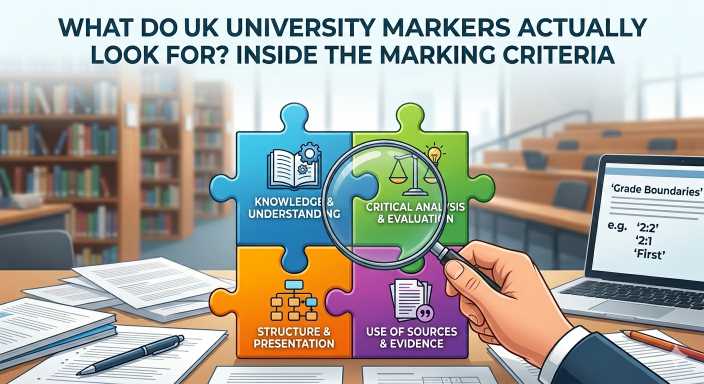
What Do UK University Markers Actually Look For? Inside the Marking Criteria
You have spent days working on an essay. You are fairly happy with it. You submit it, wait two weeks, and then get a 58%. No detailed feedback, just a grade and a few vague comments about needing more critical depth. Sound familiar? The truth is, most students submit their work without fully understanding how it will be marked. Every UK university uses some form of marking criteria, and once you know what those criteria actually mean, you can tailor your writing to hit every single point your marker is looking for. The Four Pillars of UK Marking Criteria While every university has its own specific rubric, most UK institutions assess student work across four main areas. Understanding these four pillars will give you a genuine advantage over classmates who write without this awareness. 1. Knowledge and Understanding This measures whether you actually understand the topic. Markers look for accurate use of key theories, concepts, and terminology. A First Class answer shows depth of understanding, not just surface level awareness. Mention relevant scholars by name, refer to specific theories, and show that you grasp how different ideas connect to each other. 2. Critical Analysis and Evaluation This is where most students fall short and where the biggest marks are won or lost. Analysis means going beyond describing what scholars have said. It means weighing up the strengths and weaknesses of different arguments, identifying gaps or contradictions, and offering your own reasoned judgement. A 2:1 essay describes and summarises. A First Class essay questions, challenges, and evaluates. If you want higher grades, spend more time on this pillar than any other. 3. Structure and Presentation Markers notice how your work is organised. A well structured essay has a clear introduction that states the argument, body paragraphs that each focus on a single point, and a conclusion that ties everything together. Paragraphs should flow logically from one to the next with clear transitions. Presentation also covers formatting, word count, referencing accuracy, and overall readability. Spelling errors, inconsistent referencing, and messy formatting will drag your mark down even if the content is strong. 4. Use of Sources and Evidence This pillar assesses the quality and range of your sources. Are you using peer reviewed journal articles and academic textbooks, or are you relying on lecture slides and Wikipedia? Markers want to see that you have read widely, engaged with the literature, and used sources to genuinely support your argument rather than just padding your reference list. The Real Difference Between Grade Boundaries A Third (40 to 49%) typically shows basic understanding with mostly descriptive content and limited sources. A 2:2 (50 to 59%) shows reasonable understanding with some analysis but often lacks depth. A 2:1 (60 to 69%) demonstrates good understanding, clear structure, and solid analysis but may not fully develop every argument. A First (70%+) shows excellent critical analysis, wide reading, independent thinking, and polished presentation. If you are consistently landing in the 2:2 or low 2:1 range and want to push higher, working with experienced essay writing experts can help you see what First Class work actually looks like in your subject area. How to Use Marking Criteria to Your Advantage Before you start any assignment, find the marking rubric for that module. Most lecturers include it in the assignment brief or on the virtual learning environment. Read it carefully and highlight the phrases that describe the highest grade band. Then, as you write each paragraph, check it against those descriptors. Does your paragraph demonstrate critical analysis? Does it use a range of quality sources? Is it clearly structured with a topic sentence and supporting evidence? If the answer is yes, you are on the right track. You might also find our earlier guide on how to write a First Class essay helpful for putting these criteria into practice with a clear writing framework. Ask for Feedback Before the Deadline Many students only see feedback after they have already submitted. But most lecturers are happy to review draft outlines or discuss your approach during office hours. Take advantage of this. A five minute conversation about your essay plan can save you from going down the wrong path. If your lecturer is not available or you want detailed written feedback on a full draft, DoMyWork is trusted by students across the UK for exactly this kind of support. Getting a second pair of expert eyes on your work before submission can make a real difference to your final grade. Next up in our student success series, we tackle time management strategies for university students so you can hit every deadline without sacrificing your wellbeing.
Read more
Best Student Side Hustles in the UK That Actually Pay in 2026
The most reliable side hustles for UK students in 2026 are tutoring at 15 to 40 pounds an hour, referral and student rep schemes at 50 to 500 pounds a month with a network, food delivery and rideshare at 10 to 15 pounds an hour, market research and user testing at 20 to 100 pounds a study, and freelance writing or design. The right one depends on your time, your network and how much hassle you will tolerate. UK students are working more side jobs than ever, and with average maintenance loans no longer covering average rent in cities like London, Manchester, Edinburgh and Bristol, it has become close to essential. The honest question is which side hustles are actually worth the time. Below they are grouped by how much effort they take to set up against how reliably they pay, so you can pick what fits your situation. Which side hustles pay best for the least setup? Student rep and referral schemes If you have a network, group chats, an Instagram following, course mates, referral programmes pay disproportionately well for the time involved. The DoMyWork student rep scheme pays UK students commission on every referral that converts to an order, and active reps report 100 to 500 pounds a month from sharing their code, for minutes of work a week. Other UK referral schemes worth a look include UNiDAYS partner programmes and Student Beans codes. Avoid anything that asks you to recruit other people rather than refer customers, which is the mark of a pyramid scheme. The honest version: referral income scales with your network and how active you are, but the time cost is low enough that almost any earnings are worth it. Tutoring If you got strong A level or degree marks in any subject, you can almost certainly tutor, with UK rates around 15 to 40 pounds an hour in 2026. Find work through platforms like MyTutor, Tutorful and Superprof, or locally through schools and parents’ groups, which often pays better because there is no platform cut. Setup is a couple of hours to build a profile and verify your qualifications, and once you have two or three regular students you have a stable 100 to 200 pounds a week. The hard part is the first few students, after which it is mostly word of mouth. Which side hustles offer medium pay for medium effort? Food delivery and rideshare Deliveroo, Just Eat, Uber Eats and Uber rideshare are the main options, typically 10 to 15 pounds an hour for UK students in 2026. You are self employed, so register with HMRC if you earn more than 1,000 pounds a year from it and set aside roughly 20 percent for tax. The honest version: pay has dropped as more people sign up, and wear on your bike, phone and time adds up, so the rates are worse than a few years ago though the income is real. Market research and user testing UK companies pay students for research, focus groups and user testing through platforms like Prolific, UserTesting and Respondent, often 20 to 100 pounds a study. Check regularly and you can realistically earn 100 to 300 pounds a month, though good studies fill within minutes. Treat it as useful supplementary income rather than something you can rely on monthly, because availability varies. Content and affiliate work If you already make TikTok, Instagram or YouTube content, you can monetise through affiliate links and creator partnership programmes, and even small accounts of 5,000 to 20,000 followers can earn 100 to 500 pounds a month with student focused brands. It works if you already make content. Trying to become a creator purely for the money usually does not. Which side hustles pay most but take real setup? Freelance writing, design or development Skilled freelance work pays well but takes time to break into, through platforms like Upwork, Fiverr and PeoplePerHour or direct outreach. The first three to six months are a slog while you build a portfolio, gather reviews and learn to price yourself, after which you can earn far more per hour than most other student work. Selling on Vinted, Depop or Etsy Resale and craft selling suit students with an eye for it. Vinted has overtaken Depop for casual clothes selling, while Etsy works for handmade and digital products. Casual sellers earn 50 to 500 pounds a month, though running an Etsy shop at scale is a small business rather than a side hustle and needs real craft or design and marketing skills. Which side hustles should students avoid? Do international students face work restrictions? Yes. If you are on a Student visa, your work is capped, usually at 20 hours a week during term for most degree level courses, with more allowed in holidays, and some activities such as self employment and freelancing are restricted or not permitted at all. Always check the conditions printed on your visa and your university’s international student guidance before taking on any paid work, because breaching the conditions has serious consequences. Do I have to pay tax on side hustle income? Often, yes. The UK has a 1,000 pound trading allowance, so if you earn more than that from self employed activity in a tax year you need to register with HMRC and complete a Self Assessment return. Employed work through an agency is usually taxed through PAYE instead. As a rule of thumb for self employed income, set aside around 20 percent for tax so a bill does not catch you out. This is general information rather than tax advice, so check the current HMRC guidance for your situation. Frequently asked questions What is the best side hustle for a UK student? It depends on your situation. Tutoring pays well if you have strong grades, referral schemes pay well if you have a network, and delivery or user testing suit flexible spare hours. Match the hustle to your time and skills. How much can a student realistically earn? Anywhere from
Read more
What Do UK University Markers Actually Look For? Inside the Marking Criteria
You have spent days working on an essay. You are fairly happy with it. You submit it, wait two weeks, and then get a 58%. No detailed feedback, just a grade and a few vague comments about needing more critical depth. Sound familiar? The truth is, most students submit their work without fully understanding how it will be marked. Every UK university uses some form of marking criteria, and once you know what those criteria actually mean, you can tailor your writing to hit every single point your marker is looking for. The Four Pillars of UK Marking Criteria While every university has its own specific rubric, most UK institutions assess student work across four main areas. Understanding these four pillars will give you a genuine advantage over classmates who write without this awareness. 1. Knowledge and Understanding This measures whether you actually understand the topic. Markers look for accurate use of key theories, concepts, and terminology. A First Class answer shows depth of understanding, not just surface level awareness. Mention relevant scholars by name, refer to specific theories, and show that you grasp how different ideas connect to each other. 2. Critical Analysis and Evaluation This is where most students fall short and where the biggest marks are won or lost. Analysis means going beyond describing what scholars have said. It means weighing up the strengths and weaknesses of different arguments, identifying gaps or contradictions, and offering your own reasoned judgement. A 2:1 essay describes and summarises. A First Class essay questions, challenges, and evaluates. If you want higher grades, spend more time on this pillar than any other. 3. Structure and Presentation Markers notice how your work is organised. A well structured essay has a clear introduction that states the argument, body paragraphs that each focus on a single point, and a conclusion that ties everything together. Paragraphs should flow logically from one to the next with clear transitions. Presentation also covers formatting, word count, referencing accuracy, and overall readability. Spelling errors, inconsistent referencing, and messy formatting will drag your mark down even if the content is strong. 4. Use of Sources and Evidence This pillar assesses the quality and range of your sources. Are you using peer reviewed journal articles and academic textbooks, or are you relying on lecture slides and Wikipedia? Markers want to see that you have read widely, engaged with the literature, and used sources to genuinely support your argument rather than just padding your reference list. The Real Difference Between Grade Boundaries A Third (40 to 49%) typically shows basic understanding with mostly descriptive content and limited sources. A 2:2 (50 to 59%) shows reasonable understanding with some analysis but often lacks depth. A 2:1 (60 to 69%) demonstrates good understanding, clear structure, and solid analysis but may not fully develop every argument. A First (70%+) shows excellent critical analysis, wide reading, independent thinking, and polished presentation. If you are consistently landing in the 2:2 or low 2:1 range and want to push higher, working with experienced essay writing experts can help you see what First Class work actually looks like in your subject area. How to Use Marking Criteria to Your Advantage Before you start any assignment, find the marking rubric for that module. Most lecturers include it in the assignment brief or on the virtual learning environment. Read it carefully and highlight the phrases that describe the highest grade band. Then, as you write each paragraph, check it against those descriptors. Does your paragraph demonstrate critical analysis? Does it use a range of quality sources? Is it clearly structured with a topic sentence and supporting evidence? If the answer is yes, you are on the right track. You might also find our earlier guide on how to write a First Class essay helpful for putting these criteria into practice with a clear writing framework. Ask for Feedback Before the Deadline Many students only see feedback after they have already submitted. But most lecturers are happy to review draft outlines or discuss your approach during office hours. Take advantage of this. A five minute conversation about your essay plan can save you from going down the wrong path. If your lecturer is not available or you want detailed written feedback on a full draft, DoMyWork is trusted by students across the UK for exactly this kind of support. Getting a second pair of expert eyes on your work before submission can make a real difference to your final grade. Next up in our student success series, we tackle time management strategies for university students so you can hit every deadline without sacrificing your wellbeing.
Read more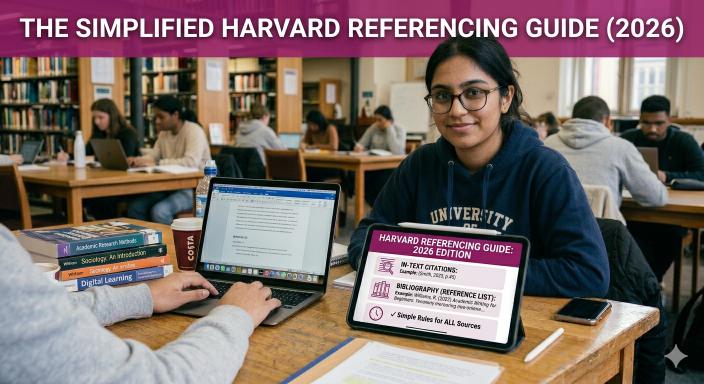
Harvard Referencing Made Simple: The Only Guide You Will Need in 2026
Let us be honest. Nobody enjoys referencing. It is the part of essay writing that makes most students want to close their laptop and walk away. But here is the thing. Getting your Harvard references right is one of the easiest ways to pick up marks that many students leave on the table. Harvard referencing is the most commonly used citation style across UK universities. Whether you are studying business, nursing, sociology, or education, there is a good chance your department expects you to use it. This guide will break it all down in plain English so you can reference with confidence every single time. How Harvard Referencing Works Harvard is an author date referencing system. That means every source you use in your essay gets two things: an in-text citation within the body of your work, and a full entry in your reference list at the end. The two must always match. If a source appears in your text, it must be in your reference list, and vice versa. The in-text citation is short and sits inside brackets. It includes the author’s surname, the year of publication, and the page number if you are quoting directly. For example: (Smith, 2023, p.45). The reference list entry at the end is longer and includes the full publication details. In Text Citations: The Basics One author: (Smith, 2023) or Smith (2023) argues that… Two authors: (Smith and Jones, 2023) Three or more authors: (Smith et al., 2023) Direct quote: (Smith, 2023, p.45) No author: Use the title in italics or the organisation name instead. One common mistake is putting the full stop after the bracket rather than before it. The citation is part of the sentence, so the full stop always comes after the closing bracket. Reference List Examples for Common Sources Books Surname, Initial. (Year) Title in Italics. Edition (if not first). Place of publication: Publisher. Example: Williams, R. (2022) Academic Writing for Beginners. 3rd edn. London: Routledge. Journal Articles Surname, Initial. (Year) ‘Title of article’, Journal Name in Italics, Volume(Issue), pp. page range. Example: Patel, A. (2023) ‘Student engagement in online learning’, British Journal of Education, 41(2), pp. 112 to 128. Websites Author or Organisation (Year) Title of page. Available at: URL (Accessed: date). Example: NHS (2024) Mental health support for students. Available at: https://www.nhs.uk/student-mental-health (Accessed: 10 January 2026). Lecture Slides Lecturer Surname, Initial. (Year) ‘Title of lecture’, Module Code: Module Title. University Name. Date of lecture. Common Harvard Referencing Mistakes to Avoid Forgetting to include page numbers for direct quotes is one of the most frequent errors. Mixing up the order of elements in the reference list is another. Students also often forget to italicise book titles and journal names, or they use different formatting for different entries. Consistency is everything in referencing. Another mistake is referencing secondary sources incorrectly. If you read about a study in someone else’s book rather than the original source, you need to make that clear by writing (Original Author, year, cited in Your Source, year). If referencing feels overwhelming, you are not the only one. Getting assignment help from professionals who handle formatting daily can save you hours of frustration and protect your marks. Organising Your Reference List Your reference list should appear on a new page at the end of your essay. Entries are listed alphabetically by the first author’s surname. Do not number them. Do not separate them by source type. Every entry should use a hanging indent, meaning the first line is flush left and subsequent lines are indented. Double check that every in-text citation has a matching entry in the list. It sounds tedious, but spending ten minutes on this check before submission can be the difference between a clean script and one covered in red pen. Before you submit, it is worth running a quick plagiarism and formatting check to make sure everything looks right. Small referencing errors can trigger plagiarism flags, so catching them early saves you a lot of stress. Up next in this series, we break down what UK university markers actually look for when they grade your essays. Understanding the marking criteria is just as important as knowing how to reference correctly.
Read more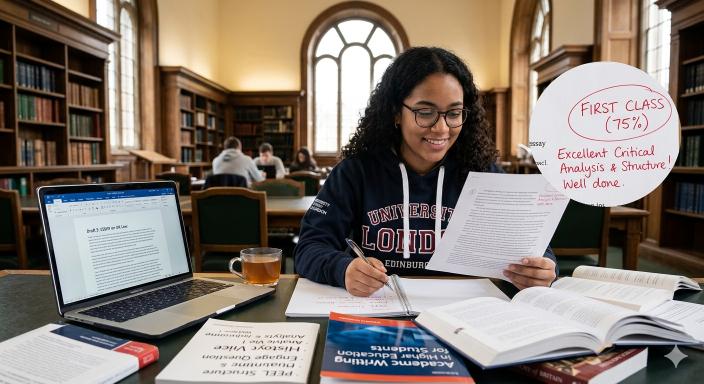
How to Write a First Class Essay at a UK University: A Complete Guide for Students
It is 2am. You have been staring at a blank Word document for the last forty five minutes. The cursor is blinking, your coffee has gone cold, and the deadline is creeping closer by the hour. If this sounds familiar, you are not alone. Thousands of UK university students go through this exact routine every single term. The good news? Writing a First-Class essay is not some mysterious talent reserved for a lucky few. It is a skill you can learn, practise, and get better at with the right approach. In this guide, we will walk you through exactly what UK university markers expect and how you can consistently produce essays that land in the top grade bracket. What Does First Class Actually Mean? In the UK grading system, a First-Class mark (70% and above) represents the highest standard of academic work. It does not mean your essay has to be perfect. What it does mean is that your writing shows independent thinking, strong critical analysis, clear structure, and solid use of academic sources. Most students think First Class essays are longer or use fancier vocabulary. That is rarely the case. The difference between a 2:1 and a First usually comes down to how well you engage with the question and whether you go beyond simply describing what other scholars have said. Markers want to see your voice, your argument, and your ability to evaluate evidence rather than just repeat it. Start with the Question, Not the Answer Before you type a single word, spend at least twenty minutes breaking down the essay question. Underline the key instruction words. Is it asking you to discuss, evaluate, critically analyse, or compare? Each of these demands a different approach. A student who misreads the question will struggle to score above a 2:2 no matter how well they write. Write the question at the top of your planning document and keep coming back to it as you draft each paragraph. Every section of your essay should connect directly to that question. If a paragraph does not clearly answer or contribute to the question, it probably does not belong in your essay. Build a Strong Essay Structure A First-Class essay follows a logical structure that guides the reader from start to finish. Here is a simple framework that works across most subjects. Introduction: State your argument clearly in the first few sentences. Tell the reader what position you are taking and briefly outline how you will support it. A good introduction is usually around 10% of the total word count. Main Body: Each paragraph should focus on one key point. Start with a topic sentence, provide evidence from academic sources, analyse that evidence in your own words, and link it back to the essay question. This structure is sometimes called PEEL (Point, Evidence, Explain, Link) and it works brilliantly for keeping your argument tight and focused. Conclusion: Summarise your argument without introducing new information. Reflect on the significance of your findings and, where appropriate, suggest areas for further research. A strong conclusion leaves the reader with a clear understanding of your position. Critical Analysis Is Where the Marks Are This is the single biggest area where students lose marks. Description tells the reader what happened or what a scholar said. Analysis explains why it matters, whether it holds up under scrutiny, and how it connects to the broader debate. If you want a First, your essay needs far more analysis than description. A useful trick is to ask yourself three questions after every piece of evidence you include. Why does this matter? What are the limitations of this argument? How does this support or challenge my overall point? If you can answer those questions in your writing, you are already thinking at First Class level. If you find critical analysis tricky, getting essay writing support from experienced academic writers can show you exactly how top scoring essays handle evidence and argumentation. Use Academic Sources Properly First Class essays draw on a range of high-quality academic sources. That means peer reviewed journal articles, academic textbooks, and reputable reports. Avoid over relying on lecture slides or websites unless they are specifically relevant to your topic. Aim to reference at least 10 to 15 sources in a standard 2000-word essay. More importantly, show that you have actually read and understood them rather than just dropping in quotes to fill space. Paraphrase where you can, and always explain how each source supports your argument. Make sure your referencing is consistent throughout. Whether you are using Harvard, APA, or another style, check that your in-text citations match your reference list. Small errors in referencing can cost you marks. If you are unsure about your referencing, our upcoming guide on Harvard referencing made simple will walk you through it step by step. Proofread Like Your Grade Depends on It (Because It Does) Never submit a first draft. Always leave time to review your work with fresh eyes. Read your essay out loud to catch awkward phrasing. Check for spelling, grammar, and punctuation errors. Make sure every paragraph flows logically into the next. It also helps to run your work through a plagiarism checker before submission. Accidental similarities can flag up even in completely original work. You can check your Turnitin score quickly and affordably to make sure your submission is clean before it reaches your lecturer. Quick Checklist Before You Submit Before hitting that submit button, run through these points. Have you answered the specific question that was asked? Is your argument clear from the introduction? Does every paragraph have a clear point backed by evidence? Have you analysed rather than just described? Is your referencing consistent and complete? Have you proofread at least twice? If you can tick off every one of those, you are in a strong position. And if you ever feel stuck or overwhelmed, remember that plagiarism free assignment help is always available when you need a hand.
Read more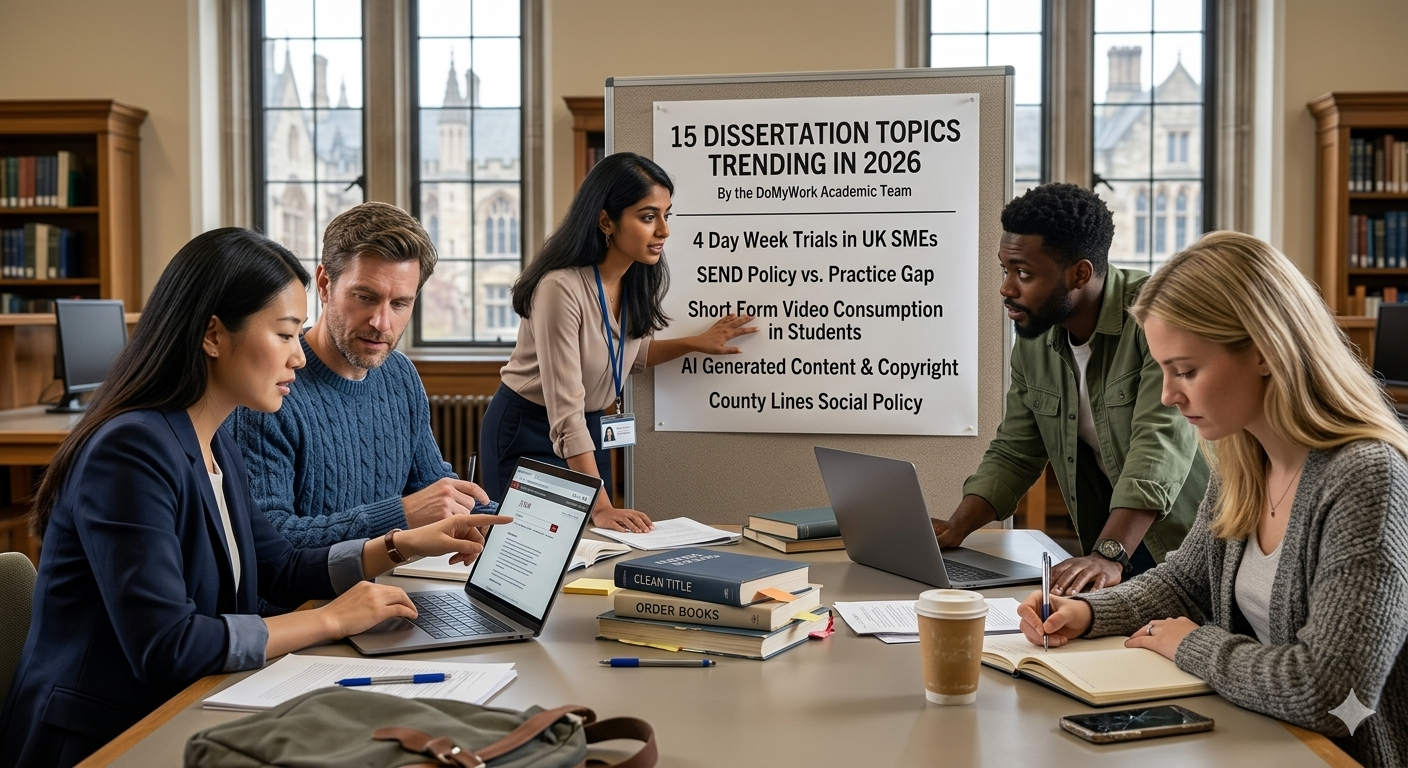
15 Dissertation Topics Trending in 2026
The best 2026 dissertation topics are specific enough to research in your time frame, backed by data you can actually access, and tied to a real gap in the literature. Strong current areas include four day week trials, ESG greenwashing, generative AI in education and business, social prescribing, and SEND policy versus practice. Pick one you will still find interesting in month six. Most lists of trending dissertation topics throw 200 vague titles at you with no guidance on whether any would pass a supervisor’s first review. This guide does it differently. You get 15 genuinely current topics for 2026, grouped by subject and written specifically enough to work as a starting title, plus a short framework for choosing between them, because the topic you pick matters more than the work you do on it. A good topic makes the dissertation easier, a bad one makes every stage harder. How do I choose a dissertation topic that gets approved? Before picking from any list, run your shortlist through the five filters supervisors apply when they read a proposal. Thinking like them saves you a rewrite. For how these feed into an approved proposal, see how to write a dissertation proposal. What are the trending business and management topics? What are the trending psychology and health topics? What are the trending education topics? AI policy in UK secondary schools: how teachers interpret acceptable use. Current because national guidance was updated and schools are writing their own policies. Suits policy analysis plus teacher interviews. Saturation low. The gap between SEND provision policy and practice in English primary schools. Current as SEND reform stayed on the agenda through 2025 with wide variation in delivery. Suits a case study. Saturation low. The effect of generative AI tools on academic integrity in UK higher education. Current and fast moving as institutions rewrite their rules. Suits a survey or policy analysis. Saturation low. How do I turn a topic into a research question? A topic is a subject area, a research question is what you will actually answer, and the move between them is narrowing. Take a broad topic such as generative AI in education and add a population, a setting and a mechanism until it becomes answerable, for example how UK secondary teachers use generative AI for lesson planning. Then decide whether you need original fieldwork or can rely on existing sources, a choice primary versus secondary research walks through. A sharp question is what supervisors approve, and it makes every later stage easier. How do I check my dissertation before submission? Whichever topic you choose, the finished dissertation is long, so plan originality checks from the start rather than leaving them to the end. Check each chapter as you complete it, then run a full document check before you submit. Use the plagiarism checker while you draft and confirm the exact figure with an official Turnitin report for $5, since a long document can hide a single overlooked match until it is too late. Frequently asked questions How do I choose a dissertation topic? Run your shortlist through five filters: is it specific enough to research in your time, can you get the data, is there a real gap, does it connect to your module work, and will you still find it interesting in month six. What makes a good dissertation topic? One that is narrow enough to answer in your time frame, backed by data you can access, tied to a genuine gap, and interesting enough to sustain you for months. Specificity is what separates a good topic from a vague one. Should I pick a trending topic? A current topic helps if there is fresh data and an open gap, but avoid saturated areas unless you have a sharp sub angle. Relevance and feasibility matter more than how fashionable a subject sounds. How specific should my topic be? Specific enough that the title could not describe five different dissertations. Narrow by country, population, time frame or mechanism until the question fits your word count and deadline. Where do I get data for my dissertation? Public datasets, published studies and existing reports are accessible at undergraduate and master’s level. Original fieldwork is possible but check feasibility first. See primary versus secondary research for the choice. Found a topic? Turn it into an approved plan with how to write a dissertation proposal, and check your finished work with the official Turnitin report for $5.
Read more
How to Write a Dissertation Proposal: Step by Step With an Example
A dissertation proposal is a short pitch, usually 800 to 3,000 words at undergraduate and master’s level, that makes the case for your research. It needs a focused question, a method that can answer it, and enough reading to show where your work fits. Most proposals contain seven sections: title, introduction, research question, literature review, methodology, timeline and references. Your dissertation proposal is the document standing between your idea and your supervisor’s approval. Get it right and you save months of rewrites. Get it wrong and you either get a polite request to rethink the scope, or you drift into writing a full dissertation on the wrong question. This guide walks through exactly what a UK dissertation proposal needs, section by section, with a worked example you can model your own on. What is a dissertation proposal, and what is it not? A dissertation proposal is a case for the research you want to do. Think of it less as a summary and more as a pitch: you are asking your department to trust you with months of independent work, and they need three things to say yes, a question worth answering, a plan that can actually answer it, and proof you have read enough to know where your work fits. It is not a first draft of the dissertation, not a review of every paper you have read, and not a contract you can never deviate from. Most supervisors expect the final dissertation to drift from the proposal, so what they want is evidence that your starting point is sound. How long should a dissertation proposal be? Length varies by level and institution, so your handbook is the final word, but as a guide undergraduate and master’s proposals usually run 800 to 3,000 words, while doctoral proposals can reach 25 to 30 pages. The point is not to fill a word count but to show a clear question, a feasible plan and enough reading to place your work. A tight, focused proposal reads better than a padded one. What sections does a dissertation proposal need? UK institutions phrase the requirements differently, but under the surface almost every proposal contains the same seven sections, in this order. How do I write the title? Your title should be specific enough that a stranger understands roughly what you are investigating, but broad enough to let the research evolve. A good test: if your title could describe five different dissertations, it is too vague. Too broad is how social media affects young people. Too narrow is how Instagram use between 7pm and 9pm affects self esteem in 19 year old geography undergraduates at one named university. About right is the relationship between Instagram use and self esteem in UK university students, a mixed methods study. Titles often change, so pick one you can defend today and refine it as your reading sharpens. If you are still choosing a subject, see 15 dissertation topics trending in 2026. How do I write the introduction and background? In roughly 200 to 400 words, set the scene: what the topic is, why it matters now, and what is already known, then end with your research question so the reader flows from context to investigation. Avoid the sweeping since the dawn of time opening, because supervisors read hundreds of proposals and spot filler in the first line. Start with a specific, current observation and tighten from there. How do I write the research question, aims and objectives? These three sit together because they are the backbone of the proposal. A common mistake is confusing aims with objectives. The aim is the what, your overall goal. The objectives are the how, the concrete steps that get you there. A reliable test is that if you can tick an objective off a list when it is done, it is written correctly. Keep the question focused enough to answer in your time frame, narrowing by country, population, period or mechanism until it fits your word count and deadline. What goes in the short literature review? The proposal’s literature review is not the full review you will write later. It has two jobs: show you know the key debates, theories or studies in your area, and identify the gap your research will fill. Most UK proposals expect 400 to 800 words here. Group the literature by theme rather than listing papers one by one, so previous research has taken two main approaches reads far stronger than a string of single study summaries. End with an explicit statement of the gap, for example that while these studies establish one thing, none have examined another in a UK context, which your research addresses. How do I write the methodology? This is the section supervisors scrutinise most, because it is where weak proposals fall apart. Cover your approach, your data and how you will collect and analyse it, and be honest about feasibility. A proposal claiming 200 interviews in six weeks is flagged instantly, and a topic needing access you cannot get is dead on arrival. Before committing to a method, decide whether your study needs original fieldwork or can be answered through existing sources, a choice primary versus secondary research sets out in detail. Supervisors prefer a modest, doable plan to an ambitious one that collapses in month two. What about the timeline and references? For the timeline, a simple month by month table or Gantt chart shows you have thought about how the work fits the time you have, including drafting, redrafting and feedback, with a proper buffer at the end because something always overruns. For references, list every source you cited in the style your department uses, whether Harvard, APA, MHRA or OSCOLA. Ten to twenty references is normal at undergraduate and master’s level, and the Harvard referencing guide covers the formatting if your course uses it. What does a worked example look like? Here is a compressed business studies example showing the structure in action. Title: the impact of hybrid working on employee engagement in
Read more